X光檢測機 vs 金屬檢測機:哪種異物檢測設備適合您的產線?

While airports use X-ray scanners for passenger security, food processors rely on them to protect brand reputation. A single undetected bone or glass shard reaching the consumer can trigger a devastating product recall.

When upgrading a production line, QA managers frequently face a critical decision: Should we install a standard food metal detector, or invest in an advanced X-ray inspection system?

To make an informed purchasing decision, you need to look beyond the initial price tag, breaking down the technical differences, detection limits, and packaging constraints of both systems, to help you choose the right foreign body detection equipment for your facility.

Magnetic Fields vs. Density Penetration

Understanding how these machines operate is the first step in determining what they can—and cannot—find.

Food Metal Detectors operate using electromagnetic fields. When a conductive or magnetic object passes through the aperture, it disrupts the field and triggers a reject mechanism. They are highly effective at finding ferrous, non-ferrous, and stainless steel contaminants. However, their detection is strictly limited to metallic materials.

X-Ray Inspection Systems operate based on density and material thickness. As X-rays penetrate the product, a sensor creates a greyscale image. Any foreign object denser than the food itself absorbs more X-rays and appears darker on the scan. Because it relies on density rather than magnetism, X-ray technology can identify a much wider range of physical contaminants.

What Can They Actually Find? A Material-by-Material Breakdown

The most significant difference between the two systems lies in their detection capabilities. If your raw materials carry risks beyond metal shavings, the choice becomes obvious.

Contaminant Type Metal Detector X-Ray Inspection System
Ferrous & Non-Ferrous Metals ✓ Yes ✓ Yes
Stainless Steel (SUS) ✓ Yes (Size Dependent) ✓ Yes (Down to 0.3mm)
Glass Shards & Ceramics ✗ No ✓ Yes (Down to 0.8mm)
Calcified Bones (Poultry/Meat) ✗ No ✓ Yes (Down to 1.0mm)
High-Density Plastics & Rubber ✗ No ✓ Yes (Depends on density)

The Foil Packaging Bottleneck & The "Product Effect"

For many buyers searching for a food metal detector, the primary motivation to upgrade to X-ray is packaging interference.

The Foil Packaging Failure: Ready meals, snacks, and powders packed in metallized film or aluminum foil severely disrupt the magnetic fields of standard metal detectors, leading to unacceptable false reject rates. X-ray systems completely bypass this issue, inspecting seamlessly through foil without dropping line speed.

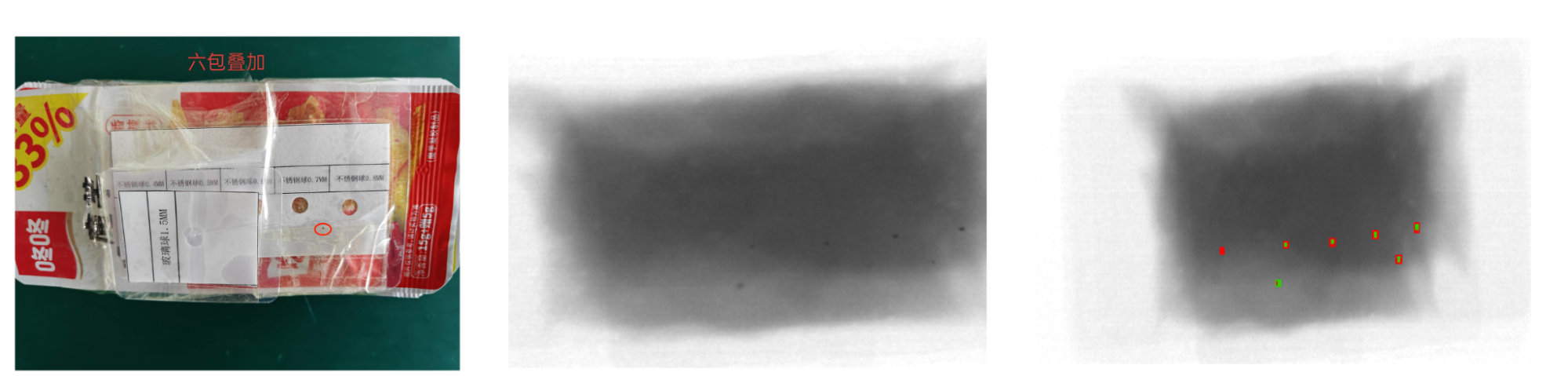
"Vista Visual X-ray systems reliably detect 0.5mm stainless steel and 1.5mm glass fragments even through multiple layers of overlapping foil-packaged snacks, completely bypassing the limitations of metal detectors.Shown above is the Vista Visual X-ray machine identifying contaminants within six simultaneously stacked aluminum foil bags."

The "Product Effect": High-moisture or high-salt content foods (like fresh meat, cheese, or baked goods) conduct electricity. This mimics a metal signal, forcing operators to lower the metal detector's sensitivity, thereby missing hazardous fragments. X-ray scanners are immune to the product effect. Temperature, salt, and moisture levels do not alter X-ray accuracy.

Pushing the Limits: Tested Accuracy at 60m/min

When evaluating equipment, buyers need hard data. Vista Visual engineers design X-ray inspection machines specifically to handle high-speed industrial processing without sacrificing precision.

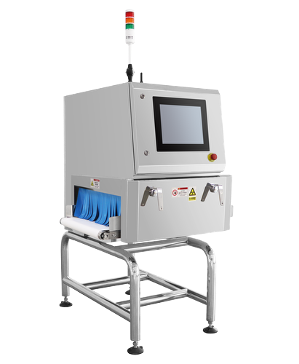
"The Vista Visual WT8051-XM1 Food X-ray Inspection System supports high-speed conveyor belts up to 60m/min while maintaining a false reject rate below 1%."

In empty-load testing environments, Vista Visual systems achieve industry-leading detection limits:

More importantly, these systems maintain stability under heavy workloads. Featuring adjustable conveyor speeds up to 60m/min, the intelligent detection algorithms restrict the false reject rate to below 1%. This ensures that your production throughput remains high while strict food safety compliance is guaranteed.

More Than Just Contaminant Removal

Unlike metal detectors, an X-ray inspection system is a multi-tasking quality control tool. A single scan can simultaneously identify foreign bodies and perform product integrity checks:

Final Verdict: Which System Belongs on Your Line?

If your process involves dry, non-conductive foods (like flour or dry pasta) packaged in standard plastic bags, a high-quality food metal detector remains a cost-effective choice.

However, you must upgrade to an X-ray inspection system if you:

  1. Package products in aluminum foil or metallized film.
  2. Face risks of glass, stone, or calcified bone contamination (e.g., meat processing, seafood, glass jars).
  3. Experience high false reject rates due to the moisture or salt content of your food.
  4. Require simultaneous missing component or fill-level verification.

Not sure if X-ray technology can detect the specific hazards in your product? Send your challenging samples to Vista Visual. Our engineering team will run them through our systems and provide a comprehensive, free detection report proving our accuracy.

Contact Our Experts for a Free Sample Test